|
| Alexandria at night. Photo Credit, the author. |
Article first published as
A Meeting at Fatima's Cafe in Alexandria, Egypt on Blogcritics.
I went on an amazing research trip to Alexandria with some colleagues the first week of July,2011. Egypt has 80 million people, and only 20 million of them live in Cairo. A good many of them, at least four million in the city itself, live in or near Alexandria. Alexandria is named after Alexander the Great, who founded the city around 300 BC. Alexandria is Egypt's northernmost port, and it defines the place where the Nile delta flows into the sea. Alexandria lies on the southern shore of the Mediterranean Ocean, and its people are a mixture of Turks, Arabs, African tribes of Upper Egypt, Greeks, Bedouins, Berbers, Spaniards, and traders of various stripes and shades.
The train ride to Alexandria takes approximately four hours, and is comfortable and scenic. As the Nile Valley turned into the Nile Delta, high rises gave way to rice farms and palm trees. Cairo is notable for its incredible overbuilding. This is to be expected in a city, which at twenty million, rivals Mexico City and Los Angeles as one of the largest metropolises in the world in terms of population. As a result, overbuilding is rampant. As the train moved out of Cairo, one of the most notable changes was less building and more farms. Because Egypt is so dry, receiving less than five inches of precipitation a year, the only farming that occurs in the country is on areas located on the Nile.
 |
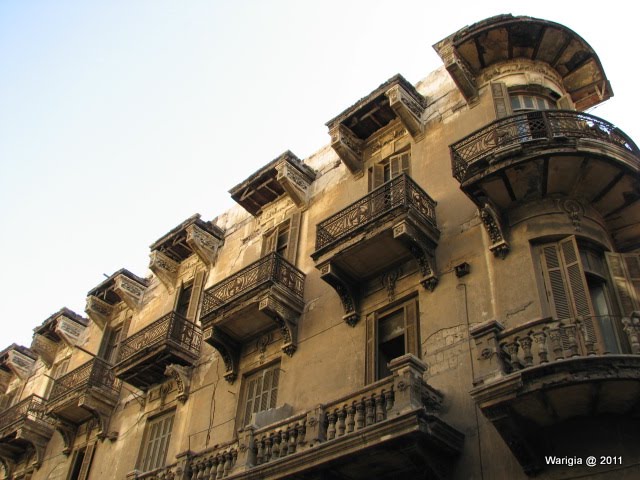
| A beautiful building in Alexandria in need of renovation |
|
Alexandria is an old city of the European type. Belle Epoque architecture characterizes the main square. The old neighborhoods could all use a coat of paint, but are nonetheless charming. One of the highlights of our trip was visiting an elderly relative of my colleague John. Tante Blanche. In Egypt, as in many Middle Eastern Nations, different streets or neighborhoods have different specialties in terms of business. Some streets sell jewelry, some streets sell wedding gowns, and some streets are full of bakeries selling the sweet delicate pastries that Egyptians favor. These business areas are referred to as “souks,” meaning markets, or bazaars. John’s Tante Blanche lived in the car repair souk. We saw a sign for a garage that said "North East African Trading Company Overland and Willys." Parked in front of Tante Blanche's house on the street was a vintage black Packard limousine from the 1930s, in mint condition. She explained that the car is rented out for special occasions, like weddings or parties. The buildings in Blanche’s neighborhood are close together, and all have balconies. We enjoyed the evening breeze on her porch. The houses across the street were not quite within reaching distance, but they were no further than 15 feet away. It struck me as a scene out of The Time and the Place by Naguib Mahfouz.
 |
| A typical Alexandrian working class neighborhood. Photo Credit, the author. |
Our research was on the popular civil militias which were created in the cities to protect neighborhoods during Egypt’s January 25th Revolution. In an effort to thwart the people’s efforts and throw the country into chaos, deposed President Mubarak released thousands of prisoners from jail, and withdrew the police. These civilian defense forces emerged from the grassroots through the country, and by January 28th, the entire country was safer than it ever had been, protected by every able bodied man, and sometimes woman, in each building. The defense forces worked on shifts and used secret passwords, and special signals, like raised windshield wipers. One major group in Alexandria was led by a gentleman of the name of Engineer S. We had not met him, we just knew of him by reputation.
He told us to go sit at a place called Hotel Nobel on the Corniche. The Corniche, from the French word cornice, is the word Egyptians use to describe the waterfront, whether on the Nile, or the Mediterranean. The Hotel Nobel was undistinguished, and we wondered why Engineer S. had selected it. As we sipped our tea we got a call. We were instructed to cross over to the ocean side by means of the underground tunnels, and meet him at a place called Fatima's Café, where the sea meets the Corniche. We seated ourselves in the plastic chairs while we watched the sun set red over the Mediterranean Ocean, as the waves smashed against the rocks. As my colleague Jennifer pointed out, it was all very cloak and dagger: "meet me on the Corniche, around sunset, at Fatima's Cafe."
 |
| Sunset on the Corniche |
About forty minutes later, Engineer S. arrived with an entourage: Fatima herself; Islam, the Bedouin from Sinai; Ahmed, a Black Arab from Upper Egypt; and Khaled, a fellow who seemed to have ties to the previous government. We feasted on fu'll and t'aamaiya (soaked beans), which are delicious and somehow addictive with a bit of salt. Engineer S. was the real deal: brilliant, brave, organized, handsome, political, and a protector of the family of Khaled Sayeed's—one of the martyrs whose memory started the Revolution. We had a fascinating and long discussion with all of them, full of informative facts about politics, religion, culture and security. As we left from Fatima's Cafe around midnight, we were exhausted, but happy.
 |
| Meeting with Popular Defense Forces |
After a long day of walking around Alexandria, we had to catch our train back to Cairo. We debated for a few minutes about where we should eat our last meal. We arrived at the rooftop restaurant of the Victorian era Windsor Palace Hotel, which could not have been a better ending to a wonderful weekend. From the rooftop, we had a panoramic view of the entire city. Alexandria stretched out in front of us in a perfect crescent, as the waves crashed on the Corniche. Alexandria had been a kind hostess. We would return.