Showing posts with label cairo. Show all posts

Tuesday, September 16, 2014

Wrap up of August, 2014, events in Egypt

-->

On the Rab'a Massacre

In a 188-page report entitled "All According to Plan: The Rab'a Massacre and Mass Killings of Protesters in Egypt", Human Rights Watch has accused the Egyptian police and army of crimes against humanity committed during at least 6 demonstrations between July 5 and August 17, 2014. The report is the result of interviews to more than two hundred witnesses, visits to the protest sites right after the attacks, and reviews of physical evidence, video footages, and statements by public officials. In particular, Kenneth Roth, executive director of Human Rights Watch, has declared that the Rab'a massacre of August 14, 2013, "was a violent crackdown planned at the highest level of the Egyptian government." Egyptian officials have tried to justify the massacre by claiming that the civilians were armed. Human Rights Watch documented the throwing of rocks and Molotov cocktails against the army forces, but it affirmed that the killing was disproportionate. In about 12 hours, 817 people were killed in what is considered "the biggest mass killing of civilians in modern Egyptian history." Moreover, the Interior Minister Mohamed Ibrahim declared that his forces found only 15 guns in the square. This massacre was not "the result of poor training or unexpected circumstances", but it had been premeditated because "the violent dispersal of the sit-in was thoroughly planned in advance". 

The main question surrounding the events in Rab'a is: "How do we explain the behavior of the Egyptian military on Tahrir in January 2011 and in Rab'a in 2013?" On one hand, in January 2011, the military at first stood by Mubarak, killing hundreds of people during the uprising. Then, a week into the rebellion, the army declared its refusal to raise its weapons against civilian protesters. On the other end, during the Rab'a massacre, the army coordinated closely with the Ministry of Defense, locking any possible way out of the Rab'a's square where people were gathered, using snipers to shoot on the crowd and bulldozers to clear the path for the gunmen. The operation was overseen by President al-Sisi, at the time "minister of defense, general commander of the armed forces, chair of the Supreme Council of the Armed Forces (SCAF) and deputy prime minister for security affairs". 

Scholars have been studying and developing theories to explain these two different behaviors of the military forces, but it is hard to reach a conclusion examining one single regime crisis. "Future research [...] would do well to account for both" events. Finally, since those events took place, Egyptian authorities have engaged in several other measures to deprive citizens and political opponents of their basic human rights. No one has been held responsible for the massacres, although the government has created a committee to investigate the human right abuses since June 30, 2014. Human Rights Watch has asked the government to provide its perspective on the events, but it has not received any response yet. One year after the Rab'a massacre, not one of the officials who perpetrated the massacre has been held accountable for it. 

Other issues regarding democratization 

On a different note, in July 2014 the Egypt's regime announced the reduction of fuel subsidies. Although the announcement generated waves of anger among the poor, many of whom are still suffering from the turmoil undergoing in the nation since January 2011, the next day the lines at the gas station across the country seemed as normal as ever. After several weeks, gas stations recorded a shift in the preference of private drivers from the 92 unleaded gasoline to the 80 gasoline, the cheap one, and to natural gas. One reason for the lack of uprisings was the deployment of riot police at several gas stations and around main arteries of Cairo. Another reason is that many decided not to protest because they estimated the cost of an uprising to be higher than heeding the government's decisions, while wealthier citizens consider inflation a natural phenomenon, and thus see no reason to protest against it. A third reason is the intervention operated by the military to open three main traffic intersections, relieving the traffic jams suffered by the eastern part of Cairo. This operation had two main consequences: it increased the value of real estate in those areas, and it had positive effects on public transportation and taxi services, since the drivers don't have to take massive detours anymore, increasing their income. Finally, according to Hatem Zayed, an economic researcher, people accepted the recent economic measures because of the fear generated by the outcomes of recent protests, and because of how gradually inflation is happening. However, although President al-Sisi keeps promising mitigation policies, he is just maneuvering around the economy. Therefore, '"it's only a matter of time before people start protesting the economic distress; it is inevitable"'. 
  
Additionally, the Ministry of Interior has launched a government project aimed to relocate street vendors from downtown Cairo to Al-Torgoman. The project has the purpose of enforcing the sovereignty of the law in Egyptian streets, as well as to deal with traffic congestion, electicity theft, and violation of public property, as declared by Major General Abdel-Tawab. Street vendors have been protesting against the measure, stating that Al-Torgoman is a non-commercial area, and that they foresee huge material losses. Hussien, head of the street vendors syndicate, affirmed that the measure took them by surprise, and that they are willing to prove that the new location is non-commercial. They will sell their products  in Al-Torgoman for five days, and decide to stay if satisfied, or return downtown if not. 

Finally, prosecutor-General Hisham Barakat is leading an investigation into the administrators of the Facebook page "Popular Resistance Movement" because it allegedly "incites against state institutions and calls for assaulting army and police personnel". The police has arrested the page's administrator, a teacher living in Qalioubiya, for posting slogans of the Muslim Brotherhood, and they have confiscated his laptop. His brother has been arrested too. This investigation follows restrictive measures enforced by the Egyptian police after the Muslim Brotherhood was declared a terrorist organization after Islamist president Mohamed Morsi was ousted last summer. Since then, hundreds of his supporters and members of the Brotherhood have been killed and thousands have been put into jail. In January, the Interior ministry has declared the beginning of arrests of users and administrators of social media websites that incite violence against the police or citizens; dozens of Brotherhood members have been accused and arrested after the announcement.

Good news: Karima El-Serify, detained in Qanater prison since mid-April, has been released by the Cairo Criminal Court under "probation measures". Karima has been on hunger strike for 68 days, and this may be the main reason behind her release, according to one of her friends. Karima was arrested and charged in espionage cases along with other members of Morsy's presidential team. Moreover, as her mother has declared, her arrest has been a way "to put pressure on her father, Ayman Al-Serify" close associate of Morsy. Karima began her hunger strike after "prison guards ordered cellmates to beat her and her colleagues and steal their belongings". Hunger strike has been used as a protest tactic by several prisoners currently detained in Egypt.

~WMB

Many thanks to my Graduate Research Assistant, Paola Cavallari 


Monday, April 1, 2013

Women's status, unrest in Cairo, and weakened protest rights


The Muslim Brotherhood has responded negatively to a newly ratified United Nations (UN) declaration, which seeks to end violence against women. They reject the declaration deeming it as misleading and deceptive and stating that it contradicts the principles of Islam and would destroy society. The National Council for Women (NCW) has dismissed the Brotherhood’s statements insisting the declaration advocates for law enforcement to execute plan to combat violence, while stressing equality in education, health, and human rights. Further, they state the claims made by the brotherhood that it violates Sharia are a “misuse of religion, and an attempt to tarnish the UN’s image in order to quash women’s rights.” Other groups see the “showdown” between the two groups as a stage due to Egypt signing the declaration, meaning the ruling party (Brotherhood) signed it, keeping appearances both internationally and locally.   Is the Brotherhood feigning a feud with the women’s council? By Dalia Rabie March 25, 2013)

The "Strong Egypt" Party launched an initiative in January called “Transportation that respects women” in an effort to alleviate sexual assault and other issues women face while in public. The microbuses are provided to offer an alternative to public transportation system that “is failing to provide a basic, respectable method of transport that meet women’s needs.” In a study conducted in Cairo and Monufiya universities, 68% of women said they had been subjected to either physical or verbal abuse. Private taxis are too expensive so many women are happy this new alternative is available to reduce the risk of harassment. However, some women’s-rights groups are concerned that it encourages gender discrimination and only treats the symptom of an overarching problem. ( Women only: Will a segregated transport system solve or perpetuate a problem? by Heba Helmy March 27, 2013) 

Meanwhile, two years after the revolution, street violence remains high, and the rule of law seems weak. 

At least 90 people were injured during clashes on Friday the 22nd between Muslim Brotherhood supporters and opponents. The opponents ransacked three of the brotherhood’s offices including their headquarters in Cairo. The Brotherhood’s spokesman said opponents attacked women who were holding mother's day commencements. Riot police defended the headquarters but did not interfere to break up the sides a few blocks away. The opposition demanded Morsi to be tried for the killings of protestors just like Mubarak. (Dozens injured as clashes erupt in Egypt  by Al Jazeera March 22, 2013)

Last week, a new round of clashes erupted in cities in northern Egypt, and protestors rallied in Cairo in the latest demonstrations against President Morsi. The clashes in Alexandria occurred between citizens, those who supported the Muslim Brotherhood, and those who oppose the group. At another location, anti-government protestors threw stones at offices that used to be home to the Brotherhood’s office before it was stormed a few weeks back. This halted train traffic for a few hours. In the Nile River Delta, protestors and riot police clashed in front of the office of Prosecutor General Talaat Abdullah. Early this week, Egypt’s prosecutor general issued warrants for five of Egypt’s most prominent advocates stating they instigated the violence over the past few months where hundreds have been injured. A few weeks ago members of the Brotherhood beat activists, including women, who were spray-painting anti-brotherhood graffiti outside their headquarters. Earlier this week, Morsi gave a speech calling his opposition thugs and warned foreign nations that are interfering in their domestic issues. “No one in our neighborhood wants this nation to stand on its feet. I will cut off any finger that meddles in Egypt.” ( Protestors rally in Cairo, clashes erupt in 2 other Egyptian cities in latest wave of unrest by Mohammed Khalil March 29, 2013)

Despite this tough talk by Morsi about foreign meddling, perhaps Morsi should work on cleaning his own house. 

Amnesty International is criticizing the Egyptian government for failing to protect Coptic Christians, the largest minority group in the country. There has been a rise in tension in religious communities and authorities have done little to relieve it. In February a Muslim woman was reported “missing” and accused a church of converting her to Christianity. Protest erupted demanding she be returned and the Coptic Christians leave the community. “Let the Christians die from fear” were common chants that were paired with anti-Christian leaflets distributed throughout public areas. After a week of protest and violence (shut down Christian stores and beat anyone who resisted), on March 25, a large group of Muslim men threw Molotov cocktails inside a Christian church and set fire the local priest’s car. Muslim and Christian elders met for a “reconciliation meeting” which agreements to allow Christian stores to reopen and for the missing woman to be returned by April 24 were made. Amnesty International state the response is poor and “reconciliation” should not be a replacement for prosecution of offenders of sectarian violence.    (Amnesty Slams Morsy for failing to protect Copts by Egypt Independent March 27, 2013)

Freedom of speech is increasingly restricted in Egypt. A draft that restricts the right to demonstrate has been approved by the Shura Council. The bill prohibits citizens from organizing protests that “pose a risk to the nation’s security.” To enforce this law, the police must approve all demonstrations three days in advance. All demonstrations must be 200 meters away from all governmental building. Anyone who violates this law will be sentenced to prison and a hefty fine.   (Shura Council passes law curbing protest rights Egypt Independent March 26, 2013)

  ~WMB

Tuesday, June 12, 2012

A worrying weekend as the Egyptian presidential election approaches

I am here in Cairo for June. Here in Cairo, things are a bit tense. My students are concerned about me. They worry that I do not have enough family to make staying in Cairo during the upcoming election safe. No matter, I have various colleagues, and we live in Rehab, which is likely the safest place in the greater metropolitan area.

Multiple political matters remain up in the air. First, who will participate in the Constituent Assembly, which is supposed to write Egypt's new constitution, is a matter of great contention. The constituent assembly is supposed to be formed of 100 people representing various components of Egyptian society. Yet, its composition has drawn enormous criticism from secular and liberal forces, including ElBaradei. Second, the Supreme Constitutional Court could disband parliament over the legality of the voting in the recent parliamentary elections. Third, this Saturday and Sunday a presidential runoff is scheduled between Ahmed Shafiq, Mubarak's last prime minister, and the Muslim Brotherhood's Mohammed Morsy. Shafiq may yet be disqualified under the Political Isolation Law. The Supreme Constitutional Court may declare the law illegal. Or, the court may choose not to hear the case.  However, the Court is scheduled to hear the case on June 14, 2012, only two days before the scheduled runoff.

If Shafiq is elected, and then disqualified, it could throw political matters--and the country-- into turmoil.

Shafiq is clearly the SCAF's preferred candidate, and his disqualification would loosen their grip on power. Also, the proximity of a potential court decision to the runoff is nerve-wracking. On the way home on the bus, everyone was making nervous jokes about our safety. One of my students says he is going to Ain Sokhna for the election. We asked him why he thinks Ain Sokhna is safer? He said, it is not safer, but at least it will be relaxing and fun. Good point.

Wednesday, December 14, 2011

Egypt elections beyond ideology: A return to common sense politics


Egypt elections beyond ideology: A return to common sense politics
By   Hamid Eltgani Ali and Warigia Bowman December 13, 2011, 5:00 pm


The first round of Egyptian parliamentary elections is drawing to a close, but in another sense, Egyptian multi-party politics is just beginning. After a partially successful revolution, Egypt is now on a crash course to multi-party democracy. Other countries that have gone through major political transitions from dictatorship to democracy generally have had decades to make the transition. The question many Western observers are asking now is what shape will Egypt’s nascent democracy take? Will it more closely resemble the secular Turkey, or the more theocratic Iran?

 As news reports have indicated, the results of the first round of elections have been discouraging for those who support a secular state in Egypt. Based on our quantitative analysis of publicly available ex post election data after the first round of voting, the Islamists performed exceptionally well in comparatively rural areas with low political capital such as Fayoum and Luxor.

By contrast, liberal and moderate parties, taken altogether, won only 27 percent of total votes and performed relatively well in highly urbanized areas of high political capital like Cairo, Alexandria and Port Said. Liberal candidates are likely to do worse in the second and third rounds of voting which will be held in parts of rural Egypt that are likely to be less progressive and politically sophisticated than Cairo, the Red Sea and The Delta.

Given results in the first round of the Egyptian elections, what lessons can be learned?

Given what we  have seen in the first round of the Egyptian elections,  what lessons can be learned? First of all, liberal parties made a serious miscalculation by running numerous separate lists. Many of the parties in the Revolution Continues Alliance (RCA) withdrew from the Bloc allegedly due to inter-party conflicts. The only liberal party that has done well in the elections has been The Egyptian Bloc, which has captured 14 percent of the available seats thus far. Liberal parties are doing even worse under the single-winner system. In the first round of runoffs, 47 of the Muslim Brotherhood’s candidates (Freedom and Justice Party) made it to the runoffs. The far right Islamist party Al Nour has secured 27 candidates in the first round of runoffs. By contrast, the Egyptian Bloc only had 9 candidates in runoffs. The liberal and moderate parties need to resolve their differences and work as a unit to gain any seats.

The second lesson to be learned is that Egyptians have not yet embraced an ideological approach to politics. The conservative right and liberal left categories which categorize Europe simply do not apply well here, accordingly labels and ideologies are not useful campaign tools. Rather, parties can more easily be divided along a crucial axis: support for a secular state, or support for a religious (Islamic) state. The second lesson to be learned here, then, all parties must figure out what matters to them and campaign on issues,  like how they will reduce unemployement, not ideologies. The Egyptian people do not know what “social justice,” means yet. But they do know what a hungry stomach feels like.

Thursday, November 10, 2011

Cairo, I missed you

I went to Taormina, Italy, for Eid al Adha. It was spectacularly beautiful. The food was good, and the wine was plentiful. The architecture was amazing. Somehow, though, I found myself longing for my family, and for dry, windy Cairo. Italy was stunningly beautiful, but also not as lively as Egypt. I missed the falafel. I missed the lemon. I missed the hectic hustle and bustle. It has been a difficult year, but Cairo has its charms.

Monday, October 10, 2011

Maspiro clashes against the Copts


Photo Credit: Mohammed Hossam Edin
  
Dear readers,

Please forgive my sketchy cite form as I attempt to get the news out.

Violence occurred last night against the Coptic people of Egypt. Ten percent of Egypt's 80 million people are Copts. Cairo on Edge After Deadly Violence A group of mostly Coptic protesters clashed Sunday with military and police forces in the Maspiro area of Cairo.  I have not been feeling well, so I learned of this from my Coptic teaching assistant. I have reached out to some of my Coptic students to make sure they are okay. They appear to be fine.
 
Sarah Carr reports that Coptic protesters rallied regarding an attack of a church in Aswan on September 30th. I summarize and paraphrase her compelling, vivid, and scary report here. The march began in the Cairo district of Shubra. (Sarah Carr, "A Firsthand account: marching from Shubra to deaths at Maspiro," AMAY 10/10/2011)  The march statred at 4 p.m. The army had apparently hit a priest while dispersing protesters in front of the Maspiro state TV building on Wednesday. The march came under attack around 6 p.m. rocks were thrown at protesters from the bridge. Outside the Ramsis Hilton Hotel, gunfire began. Two armored personnel carriers started driveing through the protesters, and soldiers began firing at random. An APC drove toward the crowd, flattening protesters. Sarah Carr, "A Firsthand Account: Marching from Shubra to Deaths at Maspiro," Al Masry Al Youm, October 10, 2011

Other reports confirm that the army shot bullets intensively once the march arrived at Maspiro. ("At Coptic Hospital, Christians Hysterical over lost relatives," AMAY, 10/10/2011) Several victims were run over by Egyptian military armored personnel carriers. According to medics at the Coptic Hospital, all dead bodies were either run over by military vehicles or shot with gunfire. The floor of the Coptic Hospital was covered by blood.

Egyptian state TV has reported that "Christian protesters stole weapons from the army and killed soldiers."

The violence at the Maspiro state TV building left 24 dead, and 272 injured. ("Clinton Made no Statement," AMAY10/10/2011) The US embassy did ask people to remain calm. US Embassy statement about Maspiro Violence

I am at the AUC campus in New Cairo, and we are perfectly safe here. The university has issued no official security warnings. I am holding class tonight, and I have told my students they can choose whether to attend.


Prime Minister Essam Sharaf warned Egyptians of a "despicable conspiracy against Egypt." ("Sharaf: We are facing a conspiracy," AMAY 10/10/2011) Is this guy serious? I really do not think the New York Times got this story completely right. But, feel free to make up your own mind. Church Protests in Cairo turn deadly


As of 12:18 a.m this morning, eyewitnesses were reporting that groups of thugs were attacking Christian-owned businesses. A fierce street battle occurred on Ramses Street near the Coptic Hospital between groups in civilian clothes. Rioters set cars on fire, and threw molotov cocktails. Hundreds of thugs attacked the Coptic Hospital but were unable to get inside. Street clashes continued until early this morning. The MB condemned the clashes, but blamed both Coptic protesters and the military. By last night, the police had control of Tahrir Square, and protesters had left the area. ("Live Updates: As death toll rises in clashes," AMAY, 10/10/2011)

Some are concerned that the clashes could have been instigated by provocateurs. I second that emotion.  It is not plausible that unarmed Christians attack the military.  Mohamed Selim al-Awa, an Islamic thinker and presidential hopeful says that he has a video clip which exonerates the Coptic protesters from shooting at army soldiers. He says that gunmen arrived from  nearby streets and shot at protesters and army forces at the same time. ("Islamic Presidential Hopefuls condemn violence," AMAY 10/10/2011) Some Muslim Activists have expressed solidarity with the Copts, stating that the problem is not between Christians and Muslims, but between the military and Christians. ("At Coptic Hospital," )

The question of the day is who is the instigator? It could be a bid by the old NDP to derail democracy. One of my colleagues suggested that it was the Copts trying to bring attention. I do not believe that, because why would the Copts attack their own hospital?  Some Islamists have suggested that the incidents in Maspiro could be a bid by the military to tighten its grip on power. This strikes me as plausible. Or it could be the military working with the NDP . . . .

And then this craziness by Presidential candidate Aboul Fotouh who says "Christians picked the wrong time and place."

Oh dear. Gloria dios, se pican los pecados del mundo, ten piedad, ten piedad.


Sunday, October 2, 2011

Public Transport workers strike


Yesterday I made my weekly pilgrimage into downtown. I live in Rehab, which is part of Greater Cairo, but kind of a suburb out in the desert near the AUC campus. I enjoy getting into town and experiencing the urban life of one of the greatest cities in the world.

I came into town and had a lovely cocktail with an editor friend of mine, at Al Masry Al Youm and a journalist friend. We went to Estoril, at Talaat al Harb, which is one of the most atmospheric of Cairene venues.

Walking back to the car in the evening, the road was blocked by large buses with large banners hanging on the front of them. There were hundreds of workers sitting on the street, smoking, drinking coffee and eating Taamiya. Apparently, this was the public transport strike which I read about in the news this morning. The workers closed Qasr al Ainy street and said they would remain until the cabinet responded to their demands.

The workers are demanding higher salaries, and improved services. According to my guest lecturer, Dr. Samer Soliman, one of the issues plaguing the public sector in Egypt is the vast inequity in public pay. In some offices, employees earn millions of pounds a month. In other offices, employees earn a few hundred pounds for similar work. These issues must be resolved as the revolution progresses.

~WMB

Monday, July 18, 2011

Fatima's Cafe: An Alexandrian Adventure

Alexandria at night. Photo Credit, the author.
 
Article first published as A Meeting at Fatima's Cafe in Alexandria, Egypt on Blogcritics.


I went on an amazing research trip to Alexandria with some colleagues the first week of July,2011. Egypt has 80 million people, and only 20 million of them live in Cairo. A good many of them, at least four million in the city itself, live in or near Alexandria. Alexandria is named after Alexander the Great, who founded the city around 300 BC. Alexandria is Egypt's northernmost port, and it defines the place where the Nile delta flows into the sea. Alexandria lies on the southern shore of the Mediterranean Ocean, and its people are a mixture of Turks, Arabs, African tribes of Upper Egypt, Greeks, Bedouins, Berbers, Spaniards, and traders of various stripes and shades. 

The train ride to Alexandria takes approximately four hours, and is comfortable and scenic. As the Nile Valley turned into the Nile Delta, high rises gave way to rice farms and palm trees. Cairo is notable for its incredible overbuilding. This is to be expected in a city, which at twenty million, rivals Mexico City and Los Angeles as one of the largest metropolises in the world in terms of population. As a result, overbuilding is rampant. As the train moved out of Cairo, one of the most notable changes was less building and more farms. Because Egypt is so dry, receiving less than five inches of precipitation a year, the only farming that occurs in the country is on areas located on the Nile. 

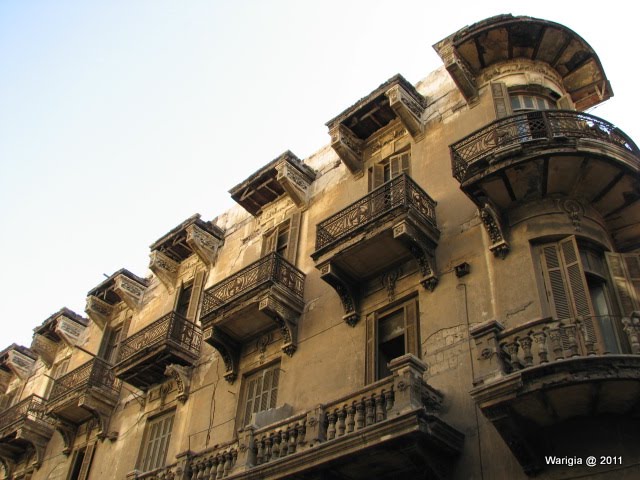
A beautiful building in Alexandria in need of renovation
Alexandria is an old city of the European type. Belle Epoque architecture characterizes the main square. The old neighborhoods could all use a coat of paint, but are nonetheless charming. One of the highlights of our trip was visiting an elderly relative of my colleague John. Tante Blanche. In Egypt, as in many Middle Eastern Nations, different streets or neighborhoods have different specialties in terms of business. Some streets sell jewelry, some streets sell wedding gowns, and some streets are full of bakeries selling the sweet delicate pastries that Egyptians favor.  These business areas are referred to as “souks,” meaning markets, or bazaars. John’s Tante Blanche lived in the car repair souk. We saw a sign for a garage that said "North East African Trading Company Overland and Willys." Parked in front of Tante Blanche's house on the street was a vintage black Packard limousine from the 1930s, in mint condition. She explained that the car is rented out for special occasions, like weddings or parties. The buildings in Blanche’s neighborhood are close together, and all have balconies. We enjoyed the evening breeze on her porch. The houses across the street were not quite within reaching distance, but they were no further than 15 feet away. It struck me as a scene out of The Time and the Place by Naguib Mahfouz. 

A typical Alexandrian working class neighborhood. Photo Credit, the author.
Our research was on the popular civil militias which were created in the cities to protect neighborhoods during Egypt’s January 25th Revolution. In an effort to thwart the people’s efforts and throw the country into chaos, deposed President Mubarak released thousands of prisoners from jail, and withdrew the police. These civilian defense forces emerged from the grassroots through the country, and by January 28th, the entire country was safer than it ever had been, protected by every able bodied man, and sometimes woman, in each building.  The defense forces worked on shifts and used secret passwords, and special signals, like raised windshield wipers. One major group in Alexandria was led by a gentleman of the name of Engineer S. We had not met him, we just knew of him by reputation. 

He told us to go sit at a place called Hotel Nobel on the Corniche. The Corniche, from the French word cornice, is the word Egyptians use to describe the waterfront, whether on the Nile, or the Mediterranean.  The Hotel Nobel was undistinguished, and we wondered why Engineer S. had selected it.  As we sipped our tea we got a call. We were instructed to cross over to the ocean side by means of the underground tunnels, and meet him at a place called Fatima's Café, where the sea meets the Corniche. We seated ourselves in the plastic chairs while we watched the sun set red over the Mediterranean Ocean, as the waves smashed against the rocks. As my colleague Jennifer pointed out, it was all very cloak and dagger: "meet me on the Corniche, around sunset, at Fatima's Cafe." 
Sunset on the Corniche
About forty minutes later, Engineer S. arrived with an entourage: Fatima herself; Islam, the Bedouin from Sinai; Ahmed, a Black Arab from Upper Egypt; and Khaled, a fellow who seemed to have ties to the previous government. We feasted on fu'll and t'aamaiya (soaked beans), which are delicious and somehow addictive with a bit of salt. Engineer S. was the real deal: brilliant, brave, organized, handsome, political, and a protector of the family of Khaled Sayeed's—one of the martyrs whose memory started the Revolution. We had a fascinating and long discussion with all of them, full of informative facts about politics, religion, culture and security. As we left from Fatima's Cafe around midnight, we were exhausted, but happy.

Meeting with Popular Defense Forces
After a long day of walking around Alexandria, we had to catch our train back to Cairo. We debated for a few minutes about where we should eat our last meal. We arrived at the rooftop restaurant of the Victorian era Windsor Palace Hotel, which could not have been a better ending to a wonderful weekend. From the rooftop, we had a panoramic view of the entire city. Alexandria stretched out in front of us in a perfect crescent, as the waves crashed on the Corniche. Alexandria had been a kind hostess. We would return.   


Thursday, July 7, 2011

Preparing for Protest


It sounds like there is going to be a really big protest tomorrow at Tahrir. Writing in Al Masry Al Youm English (almasryalyoum), Noha El Hennawy states that Friday, the 8th of July is going to attract thousands. Her article is linked above, but to paraphrase, people are frustrated with the SCAF. Many of the Revolution's demands went beyond simply replacing Mubarak. The people also asked for freedom, integrity and social justice in their slogans.

According to the Arabist, the Muslim Brotherhood is planning to participate in tomorrow's protests. In general, the MB, reports the Arabist, has shied away from protests. Yet Ursula Lindsey suggests that it is time for them to fall in line with the popular mood.

Well, I was just at Tahrir today, for a second interview with Abdel Ghaffr Shokr. On my way out of town, back to New Cairo, we got stuck in a severe traffic jam near Tahrir. I was actually stuck in traffic literally next to the roundabout, the Midan, for about thirty minutes, so I had plenty of time to observe.

Here is what I saw at about 3 in the afternoon on Thursday. The entire roundabout has been cordoned off by the protesters (I presume) with green and yellow plastic nylon ropes in a kind of makeshift fence of sorts. There are many tents on the square. Some are military style plain white canvas pup tents. Some are the pup tents with revolutionary slogans written on them in Arabic in black and red paint. Another popular style of tents are made out of large flags put together. The Libyan and Palestinian flag are popular choices, and one tent had a roof made out of the Chinese flag.

The square has both men and women on it. I saw a Nekabi wandering around making preparations. Many youth were in evidence, sporting Palestinian style red and black checkered headscarfs to mark themselves as revolutionaries. One tent had older men, around fifty, with younger men, around twenty, and some very small revolutionaries, around five years old asleep in a heap under the shade of the pup tent.

Banners are already up, as is a stage, and the Egyptian flag is everywhere. The square is a bit worse for the wear. It is clean, more or less, but the grass is quite trampled, and cigarette butts litter the ground.

My university has issued stern warnings.

·       Anyone planning to travel to areas in Egypt outside Cairo should cancel their travel.
·        When you travel inside Cairo, limit all movements to the most essential only, and plan alternative routes avoiding large gatherings.
·        Avoid all rallies because of a credible risk of localized unrest.
·        Exercise caution when passing by government buildings, police stations and military barracks.
·        Treat members of the security forces you encounter with patience and respect, and follow all instructions promptly. Carry photographic identification and a mobile phone.
·        As a reminder, please ensure that you have an adequate supply of food in your home in the event that services are interrupted.
·        Keep updated on the situation by following media reports.
Hold on to your hats, folks. This one could be big! I will be staying indoors with my three children myself.  WMB

Saturday, April 30, 2011

update on Amr El Shalakany via twitter

May 2, 2011

10:54 a.m.

Tweets say Amr has been released. In my office at AUC. No law faculty around. I asked the staff secretary and she says she knows Amr has been released. She does not know whether charges are pending or not. I will keep you posted.

Nell Lancaster
RT @: Amr el-Shalakany has been released. ||Yay! Thanks.Hadn't checked my Egypt list yet, distracted by other nooz.

 00.48 a.m.

no new tweets of substance

22.19 p.m. April 30th.

 naly 


Amr Shalakany transferred from military to ordinary prosecution in El Tur.  

 dalia bayoumi 


Amr El Shalakany Prof.Law Cairo Uni & AUC arrested in Sharm 3 days ago. in Suez @ Military Prosecution 4 trial Lawyers & activists on way

 allison brown 
RT @: Egyptian Military arrested AUC law professor AmrShalakani in Sinai resort Sharm el Shaikh. Now with military prosecutor.


 The Daily News Egypt 


AUC law professor to be tried before a military court  

 Mostafa Hussein 


Why is Amr El-Shalakany, a law professor in AUC, facing a military trial? WTF?

Rain in the Desert


It has been raining a lot lately in Cairo. The average rainfall in Cairo is one inch a year. Since March, it has rained four times. Yesterday it rained heavily for an hour, with large, round raindrops, which evaporated on the hot concrete. My taxi driver, Emad, remarked yesterday that he does not understand why there is so much rain, but is pleased about it. You can smell the rain when it is on its way in the desert. I grew up in the New Mexico desert, so I know the smell. It is a delicious, earthy, full smell which makes you feel happy and alive.

The desert is blooming. Bougainvillea vines (Bouganvillea glabra), previously merely undistinguished climbers, are exploding in a profusion of pink, magenta, and orange leaves. Jacaranda trees (Lamiales Bignoniaceae, genus Jacaranda) shade the streets with blooms of a deep violet. Cassia trees (Senna bicapsularis or possibly Cassia spectabilis) produce an abundance of golden flowers. Closer to the ground, the grass is a sturdy, intense dark green, shrubs of Lantana (Lantana camara), a hardy dry weather plant favored by goats, is growing wildly in clusters of tangerine and red balls flecked with white. Bright red hibiscus (Hibiscus Rosa-senensis) are coming into their own with showy flowers. The shrubs are thin, and not as abundant in Egypt as in Hawaii, but they do a wonderful job of livening up the gates of my drab monochromatic residential estate of El Rehab.

I wonder if the high amount of rain Cairo is receiving has anything to do with global warming? Geographer David Rutherford, recipient of a one million dollar grant from the National Science Foundation for climate change education notes:


"Global warming produces greater energy in the atmospheric system, and that produces the potential to cause more and stronger weather (weather of all sorts). Also, warmer air holds larger amounts of water, but it also increases the rate of evaporation and transpiration (from plants). Consequently, the actual affects of increasing temperature on rain and weather events is uncertain. In addition, these effects vary from place to place, and the question of whether global warming is causing more or less rain or weather events in any particular place is difficult to determine."

The Saharan climate is fragile and it is volatile. A warmer Africa with very small increases in rainfall could green the Sahara quickly, leading to a virtuous circle of increased rainfall due to more green bio mass. Max Claussen of the Max Planck Institute for Meteorology has looked into this possibility.

Yet, increasing desertification remains a danger for the Sahel and Sahara. If pastoralists drive their herds into greening areas, this could destroy the positive effect increasing vegetation has on the climate. In addition, the southern edge of the Sahara is home to a rapidly burgeoning human population, which is placing severe pressure on waterways such as Lake Chad and the White Nile. According to National Geographic, North Africa is the area of greatest disagreement among climate change modelers.

~WMB

Thursday, February 17, 2011

Ghost Cities

Today has dawned bright and cleared in the desert. Yesterday it rained a bit, so the air is very clean, and the sun is extremely bright.

The New AUC campus is in New Cairo, in the Fifth Settlement. When it was built five years ago, there was absolutely nothing out here. It is sort of near El Katameya on the far southeastern side of the city.

Now the New AUC campus is being slowly surrounded by new construction. People tell me that many of the developers are from the United Arab Emirates. There are thousands and thousands of half constructed empty buildings. Many of them are quite grandiose with elaborate plaster edifices and columns. The buildings are usually four stories high. There are no gardens or yards. They are zero lot construction. They are also just jammed together with very little space between them.

Clearly, there is no zoning and no urban planning going on. What is worse, is that there do not seem to be any shops to service these miles of fancy buildings. No one lives in the buildings, and many of them are only partially built. Part of the problem is that there are very few investment vehicles for wealthy Cairenes or Egyptians, so they have a tendency to over-invest in real estate. In addition, people often run out of money before completing buildings, leaving half built empty buildings in the middle of the desert.

This is all a potential economic disaster. What if people do not actually rent or buy these houses? Also, there is a catch 22: no one wants to build a store because no one lives in the neighborhood, and no one wants to live in the neighborhood because there are no stores. The ghost cities "landlock" capital. This has already happened in Ireland.

Ghost towns plague Ireland as unsold houses litter the country
http://www.irishcentral.com/news/Ghost-towns-plague-Ireland-as-unsold-houses-litter-the-country.html